

Old Goat Face
A Sunday morning conversation with Dodgers shortstop Cesar Izturis became a reminder that the greatest acts of love are rarely measured by what they cost.

My favorite baseball story was told on a Sunday morning in a quiet locker room that I recall smelled of coffee and bacon. It could be that all baseball parks sound and smell like that on Sunday mornings, which still makes it true.
On this morning, a 25-year-old Venezuelan shortstop named Cesar Izturis was in front of his locker. He sat on a metal chair that faced the center of the room, which was empty except for a reporter waiting for someone else. Cesar was a so-so hitter, but didn’t strike out much, and had the able hands of a young man whose way to the big leagues had seen few perfect infields.
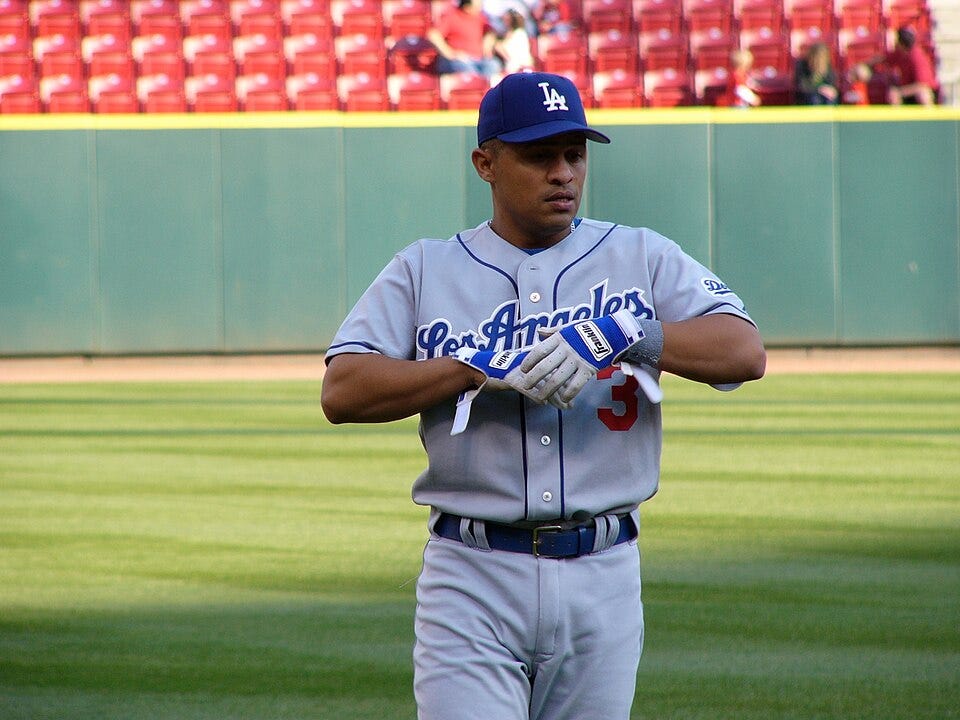
When he spoke, the words came out soft and shaded in practiced English. He smiled with his whole face, his shoulders too. And so he was likable and easy to root for on a Dodgers team that seemed determined to finish in last place or close to it.
It’s not uncommon for reporters to stand in clubhouses doing nothing but shifting their eyes from the clock to the door. Most everybody gets used to it. The day’s story rests somewhere between time and opportunity, which explains the obsession with clock and door.
Cesar pounded on a new glove. Someday it’d be his gamer. That morning it’d have to endure the early rigors of being broken in, a process that is as varied among ballplayers as batter’s box tics. Cesar wielded a small, heavy club, the head of which landed in the pocket with steady, violent, loving thumps.
Meanwhile, the clock. The door. The clock. The door.
“Cesar?” I said, time to kill, boredom having overtaken me.
He looked up.
I nodded at the glove.
“Remember your first one?”
He said nothing but pulled a nearby chair closer to his, inviting me to sit, against the rules of reporter clubhouse decorum. I sat.
“My father …,” he began.
And this was the story.
Cesar was born and raised in Barquisimeto, an agricultural hub near the northern tip of the Andes mountain range. His father, also Cesar, ferried fruit and vegetables from local markets to small mountain towns, some of which were a day’s drive away. He could be gone for most of a week, then return home before starting the route again.
The elder Cesar drove a blue 1954 Chevy pickup, which sagged in places and rusted in others, had flared fenders, two droopy headlights and a flat, grimacing front bumper. Young Cesar and his five brothers took to calling their father’s truck “Cara de Cabra Vieja.”
Old Goat Face.
Cesar, the son, was closest to his younger half-brother, Maicer. They shared bunk beds and a love for baseball. They took turns with a wood bat, counting swings at a tire their father hung from a mango tree in the yard.
“One hundred a day,” he’d instructed.
Their father worked hard, but the money only went so far.
The Izturis boys wore shabbier clothes than their classmates. Their only baseball gear was the bat; during neighborhood or recreation league games, they taped their shoes so they’d last another season and borrowed gloves from the other boys.
Smaller than most, Cesar and Maicer proved to be unusually adept at the sport. They were fast and smart, playing intuitively in the middle of the infield, drawing comparisons in the neighborhood to a young Aparicio, a young Concepcion, a young Vizquel, countrymen who’d become baseball heroes.
When he went to the market or to church, their father would hear about his sons, still in grade school, how they were so good at baseball, that they were destined for greatness, how proud he must be.
One afternoon the boys returned home from school. Old Goat Face was not in the driveway. They assumed their father was again on his route in the mountains, that he’d be home again in a few days. Except when they opened the front door, he was in the living room, sitting in a chair, as if he’d been waiting for them.
“I have a surprise,” he told them.
He reached behind the chair and in each hand he held a brand new baseball glove. He’d sold Old Goat Face for $60, made up the rest with money he’d saved and arranged to go to work with his brother, who ran the same mountain route.
Cesar still remembered the details of that glove, but mostly, he said 16 years later, “The smell.”
I smiled and began to rise from the chair. “Great story,” I said.
“There’s more,” Cesar said.
When he was 16, Cesar signed a professional contract with the Toronto Blue Jays. Two years later, Maicer signed with the Cleveland Indians.
In 2001, when he was 21, Cesar debuted in the major leagues, playing in 46 games at second base and shortstop for the Blue Jays. He returned home that winter as a big leaguer, with big league money in his pocket.
On a warm afternoon soon after he’d arrived in Barquisimeto, he asked his father to accompany him on an errand. They drove together into the city. Cesar steered into a car dealership, then led his father to a row of new pickup trucks. He pointed to a blue one.
“There’s your car,” he said. “There’s Old Goat Face.”
He’d bought it for his father.
Cesar played in the major leagues for 13 seasons. He was an All-Star once and won a Gold Glove at shortstop. Maicer was a major leaguer for 11 seasons. Together they had nearly 2,000 hits.
Weeks after Cesar told me his story, I met the elder, Cesar. He was built lean with strong wrists. He smiled as Cesar did. I asked him about Old Goat Face and the new gloves and the day his son replaced that old pickup truck, repaying the debt.
He raised his hands to his head, making his fingers into horns, like a goat, and laughed.
“The real payoff,” he said through a translator, “was not that they made it to the big leagues. The real payoff was that day. Even if they never made it, I’d do it again.”
This was awesome
Great story, and all from a simple question.